
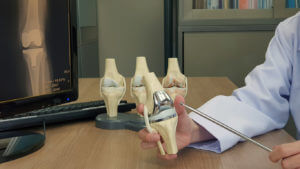
Arthritis in the knee can cause pain and stiffness, making it harder to move around. Over time, it can get so bad that simple, everyday tasks become a challenge. Total knee replacement surgery for arthritis is often the best option to feel better and move more easily.
A key part of this surgery is choosing the right knee implant. The type of implant used can affect how well the surgery works and how quickly someone recovers. Since everyone’s knees and needs are different, it is important to understand the options available.
Let us explore the different types of knee implants and how to make the best choice with your doctor’s help.
Types of Knee Implants for Total Knee Replacement
Knee implants come in various designs and materials. Each type is designed to accommodate different patient needs and ensure a successful replacement. Below are some common types of knee implants categorized based on their designs and functions.
1. Fixed-Bearing Knee Implants
Fixed-bearing knee implants are a common choice for knee replacements. They have a plastic piece that stays firmly attached to a metal base, allowing smooth movement between the knee parts.
These implants work well for people who are less active or have simpler needs. They are designed to be durable and stable and have been proven to work effectively over time.
2. Mobile-Bearing Knee Implants
Mobile-bearing knee implants are made with a moving plastic piece that can rotate slightly. They help imitate the knee’s natural movement.
These implants are a good choice for younger people. They are also a great fit for more active patients who need better flexibility and a wider range of motion. One big advantage is that the design helps reduce wear and tear on the implant, making it more durable over time.
3. Posterior-Stabilized Implants
Posterior-stabilized implants are made for people with weak or missing posterior cruciate ligaments. They have a special raised part in the middle of the joint that takes over the job of the ligament.
These implants provide extra stability. They are ideal for those who need more support for smoother and more reliable movement.
4. Cruciate-Retaining Implants
Cruciate-retaining implants are made to keep the posterior cruciate ligament in place. They use the patient’s own ligament to provide support and stability for the knee.
These implants are a good choice for people with strong, healthy ligaments and help maintain a natural range of motion.
5. Bicompartmental and Unicompartmental Implants
Bicompartmental and unicompartmental implants are used to replace only the damaged parts of the knee. They do not replace the entire joint.
These implants are ideal for people with moderate damage affecting just one or two sections of the knee. They help keep more of the natural bone, making surgery less invasive and recovery faster.
6. Gender-Specific Implants
Some knee implants are made to fit the natural shape of men’s or women’s knees. Gender-specific implants are designed to match the narrower knee structure often found in women.
These implants can be a great option for anyone whose knee shape needs a more customized fit. They help improve comfort and alignment after surgery.
7. Custom-Fit Implants
Custom-fit knee implants are made using advanced 3D technology to match the exact shape of a patient’s knee.
These implants offer a highly personalized fit. This makes them a great choice for people who want the most precise alignment. This tailored design helps improve movement and reduces the chance of post-surgery problems.
8. Cemented Vs. Cementless Implants
Cemented implants use a special glue to attach the implant to the bone. Meanwhile, cementless implants depend on the bone growing naturally to hold them in place.
Cemented implants are a good option for older adults or those with weaker bones. Cementless implants work well for younger, active people with strong, healthy bones.
The type of implant a surgeon will use is based on what best suits the patient’s needs and lifestyle.
How Your Orthopedic Doctor Helps You Choose the Best Implant
Selecting the right knee implant is a decision made between the orthopedic doctor and the patient. Your doctor considers different factors when choosing an implant for total knee replacement for arthritis.
- Anatomy and Physiology: The size, shape, and condition of your knee joint play a significant role in the choice.
- Lifestyle and Activity Level: Active individuals may need an implant designed for better mobility and durability.
- Age and Bone Health: Older patients with weaker bones may benefit from certain designs.
- Severity of Arthritis: The extent of joint damage will influence whether a custom fit or a standard implant is better.
At Advanced Orthopedics New England, our leading knee replacement specialists will conduct a thorough assessment and discuss your options. Then, they will recommend the best implant for you based on your unique needs.
Total Knee Replacement for Arthritis in Springfield, MA, and Bloomfield & Rocky Hill, CT
At Advanced Orthopedics New England, our experienced specialists—Dr. Scott Bissell, Dr. Matthew Grosso, Dr. Steven F. Schutzer, and Dr. Brett Wasserlauf—are experts in knee replacement surgeries. They are here to guide you through every step, from choosing the perfect implant to recovery.
Call our Springfield office today at (413) 788-7321. You can also reach out to our Bloomfield and Rocky Hill offices at (860) 728-6740 to schedule a consultation.
We look forward to serving you!